


Table of Contents
ToggleWith the ongoing appetite for clean, reliable, and affordable energy, many organizations and industries are beginning to work with Independent Power Producers (IPP) for their power. Whether it is solar, wind, hybrid or another renewable resource that you select for your partnership, your partner may either create or limit your ability to implement your long term energy strategy.
When considering an Independent Power Producer’s regulatory compliance, viability, experience, and social responsibility, the following are a few key considerations that you should always evaluate.
This guide will summarize those key considerations when selecting an Independent Power Producer and provide businesses with practical assistance, informed decisions and plans for the future.
What Are The Key Factors To Consider When Selecting An Independent Power Producer?
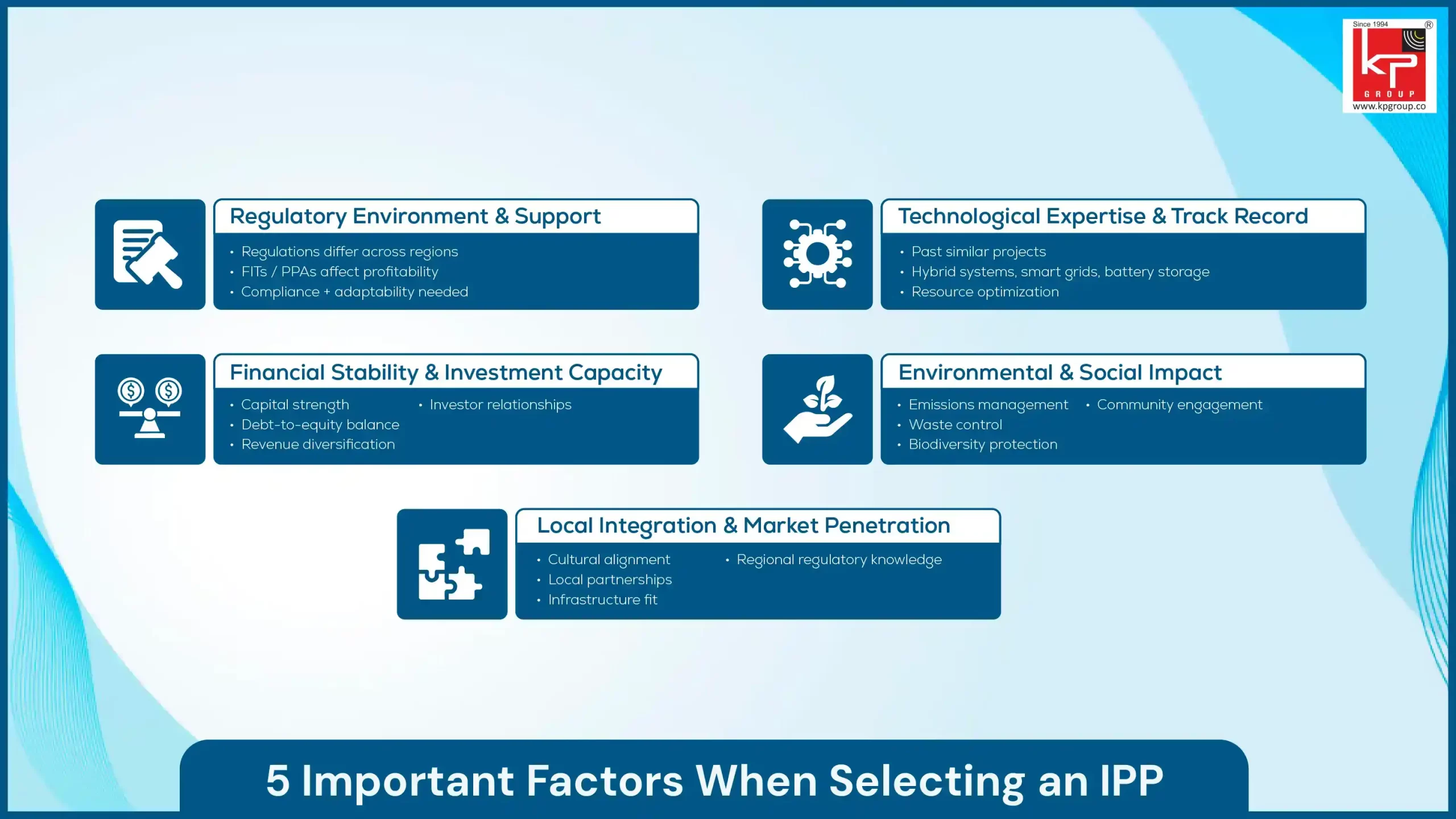
Considerations business will take into account when assessing options from Independent Power Producers will always want to ensure they are fulfilling their ‘today’ needs while facilitating their corporation’s energy strategy, including longer-term sustainability objectives. There are five key information considerations businesses would be wise to consider:
- Regulatory Environment And Support Mechanisms
- Technological Expertise And Track Record
- Financial Stability And Investment Capacity
- Environmental And Social Impact
- Local Integration And Market Penetration
Let’s explore each factor in detail.
1. Regulatory Environment And Support Mechanisms
The first step in independent power producer evaluation is understanding the regulatory landscape of the region where the project is being developed.
Why This Matters
- Energy laws, grid policies, and compliance frameworks differ significantly across states and countries.
- Inconsistent or unfavorable regulations can delay projects and increase costs.
- Support schemes such as feed-in tariffs (FITs) or power purchase agreements (PPAs) can determine project profitability.
Key Considerations
- Compliance: The IPP should keep in compliance with local and international rules applicable to energy generation, distribution, and environmental compliance.
- Stability: Political stability and greater economic stability will directly impact the enforcement of regulatory decision-making.
- Adaptability: The energy environment is dynamic, and the selected IPP needs to show flexibility to allow for law changes.
2. Technological Expertise And Track Record
How Does An IPP’s Experience And Track Record Impact Project Success?
Technology is at the core of power generation. The IPP project experience and track record are critical indicators of their capability to execute complex projects and deliver reliable outcomes.
What To Look For
- Past Projects: Review the IPP’s portfolio to know about the experience with projects similar to yours in scale and technology.
- Innovation: Leading IPPs invest in advanced solutions such as hybrid systems (solar + wind), smart grid integration, and cutting-edge battery storage.
- Resource Optimization: It is cost-saving and helps to optimize land, labor, and renewable resources.
Key Technological Trends
- Hybrid Power Systems: The pairing of solar and wind takes advantage of the different generation profiles of wind and solar making sources to result in increased efficiency.
- Energy Storage: Advanced storage options can help during fluctuations and provide assurance of renewable energy when it’s most needed.
Dos And Don’ts
- Do: Choose an IPP that invests in innovation and offers strong technical support.
- Don’t: Overlook their after-sales services or ability to scale with your growing energy needs.
By choosing the right IPP with proven expertise, businesses significantly reduce the risks of project delays or technical inefficiencies.
3. Financial Stability And Investment Capacity
Why Is The Financial Stability Of An IPP Important?
A financially strong Independent Power Producer (IPP) will have better capacity to generate projects on time, risk management capacity, and continuing operational capacity over decades. On the other hand, a financially weak independent power producer may struggle with funding and potentially not abe ble to have reliable projects.
Financial Evaluation Checklist
- Capital Strength: Is the initial project provider sufficiently capitalized to establish, upgrade, and expand?
- Debt-To-Equity Ratio: A moderate ratio indicates proper financial management.
- Revenue Diversification: Several sources of revenue diminish reliance on one market for energy.
- Investor Relationships: Strong partnerships with investors or banks indicates the market believes in you.
Real-World Impact
For the renewable sector in the large, projects are typically run on a 20 -25 years with the partnership being key to the ongoing service provided, and to be able to invest into upgrades and innovations.
This makes financial strength a non-negotiable factor in choosing the right IPP for long-term success.
4. Environmental And Social Impact
Sustainability isn’t just a buzzword—it’s a responsibility. Businesses today are expected to align with eco-conscious partners. Evaluating the environmental and social impact of your IPP is a key part of the decision-making process.
Environmental Factors To Assess
- Emissions Management: Solar, wind, or hybrid is preferred from producers that prioritize renewables.
- Waste Control: Minimizing pollution through waste management at both construction and operational levels will reduce environmental impacts.
- Biodiversity Protection: Assess whether the project affects local wildlife and habitats.
- Renewable Focus: Producers that focus on solar, wind, or hybrid producers should be considered first.
Social Considerations
- Community Engagement: Does the IPP add value to local communities through any of the following practices? Job creation, infrastructure development, or other CSR activities?
- Health and Safety: Strong health and safety protocols protect workers and surrounding communities.
Companies dedicated to sustainability benefit more than goodwill from regulators; they obtain more brand recognition and trust from their customers. Working with an environmentally conscious IPP has the compounded benefit of working with independent power producers.
5. Local Integration And Market Penetration
What Risks Should Businesses Evaluate Before Choosing An IPP?
One common risk is a lack of local integration. An IPP that understands regional market dynamics ensures smooth operations and quick responses to challenges.
Local Integration Checklist
- Cultural Alignment: Familiarity with the local environment will assist in the local acceptance of the project.
- Local Partnerships: A sound understanding of local energy regulations can save projects time and money in the policy development and approval processes
- Infrastructure Fit: Projects must integrate seamlessly with existing grids and infrastructure.
- Regulatory Compliance: Having local knowledge about energy policies allows the project to avoid expensive delays with policy and approvals.
For instance, an Independent Power Producer in Gujarat not only has to conform to national energy regulations but also comply with state’s policies concerning renewable integration and land use.
How To Ensure Long-Term Reliability When Partnering With An Independent Power Producer
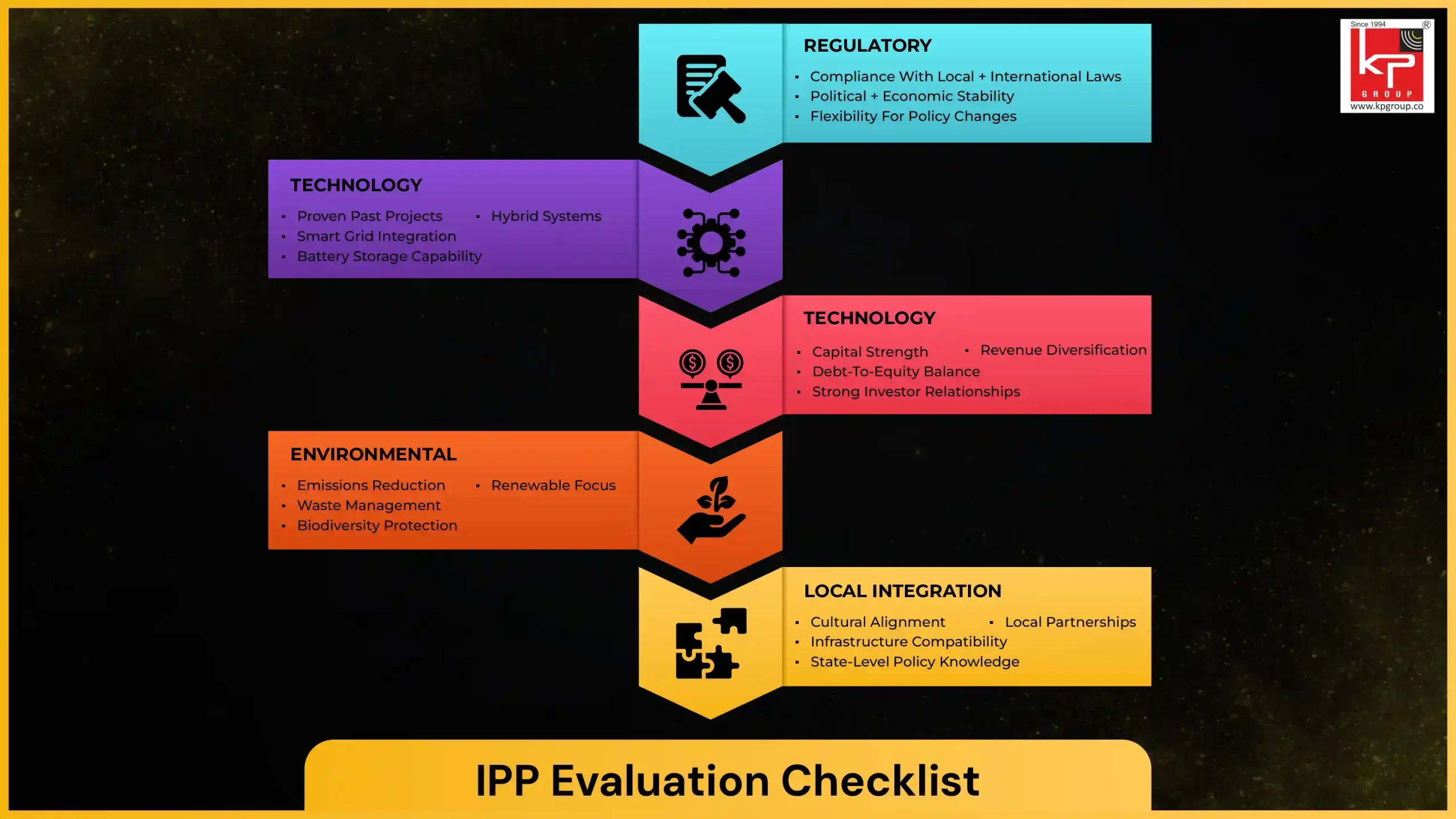
When working with an IPP, a business will want to focus on more than just the short-term delivery of the project and to assess the IPP’s relatedness for future energy requirements..
Best Practices
- Scalability: Ensure the IPP can expand projects to match your business growth.
- Technology Upgrades: Practically guarantee that, prior to any contractual signing the IPP understands and has accounted for that they will be dealing with technology upgrades in order to embrace futureproof technology (I.e., Smart Grids, Hydrogen).
- Maintenance Contracts: Comprehensive O&M (operations and maintenance) services ensure system reliability.
- Transparent Communication: Long-term success depends on clarity around pricing, performance, and timelines.
Build a long-term, sustainable power partnership. Connect with KP Group’s experts now.
Why Choose KP Group For Your Renewable Energy Solutions?
With 31+ years of experience, KP Group has become India’s leading trusted provider in the renewable energy sector. The company is respected for implementing large-scale solar and wind, hybrid energy projects across Gujarat and other states while ensuring environmental richness and executing performance. Over the years, KP Group has developed a strong reputation for providing impactful, reliable, and green energy.
What Sets KP Group Apart
- Proven IPP Project Experience and Track Record: At KP Group, we have delivered multiple MW-scale solar farms and wind parks. We work efficiently and with demonstrated performance.
- Strong Financial Base: Over the decades, we have built multiple facilities, allowing KP Group to specialize in providing value to clients.
- Sustainability Commitment: We always strive to minimize environmental impacts during projects and engage relevant local communities with consideration of any cultural constructs.
- Future-Ready Approach: The way that green hydrogen is a dynamic investment confirms a future-ready approach.
For businesses ready to begin an Independent Power Producer (IPP) in India, KP Group is an established choice that delivers both tactical return and ongoing long-term energy certainty.
Frequently Asked Questions:
Ans: Factors need to be considered, such as regulatory compliance, technical capacity, financial viability, environmental responsibility, and local engagement.
Ans: Ultimately, it affects responsibility in executing projects and maintenance of these over time, and financial stability also allows for regular investment in upgrades and innovation over time period of decades.
Ans: By taking a proven track record on utility projects, risks of delayed projects, technical inadequacies, and cost overruns can be minimized, and you can be relaxed in the surety of a successful outcome to the project, and will be reliable over time.
Ans: The key risks include weak financial standing, poor regulatory history, inadequate local integration and experience, and inadequate technological competence.
Ans: Look for scalability, a company that regularly invests in updating technology, has strong maintenance service, and provides transparency in their operations and pricing.


